Livonia is one of Wayne County’s largest suburbs, home to a wide range of post-war residential subdivisions as well as a significant industrial and commercial corridor along Schoolcraft Road and Plymouth Road. That variety means demolition needs in Livonia can range from a single-family ranch home teardown to the removal of a warehouse or light-industrial building. This guide covers the basics of how Demolition Contractor Livonia works across these different project types.
Residential Demolition in Livonia’s Neighborhoods
Much of Livonia’s housing stock was built during the rapid suburban expansion of the 1950s and 1960s, meaning many homes share similar construction methods and materials from that era. Common residential demolition projects include full teardowns to make way for updated construction, removal of detached garages that no longer meet modern vehicle sizes, and partial demolition tied to kitchen, bathroom, or addition renovations.
Industrial and Commercial Demolition
Livonia’s industrial corridor includes a mix of manufacturing facilities, warehouses, and commercial buildings, some of which have been in continuous use for decades. Demolishing these structures typically involves more complex planning than residential work, including structural engineering review, coordination with utility providers for larger service disconnections, and in some cases addressing industrial equipment or fixtures that need to be removed before the building itself can come down.
The Site Assessment Process
Regardless of project type, demolition begins with a detailed site assessment. For residential properties, this typically focuses on lot access, neighboring homes, and any landscaping to protect. For industrial or commercial sites, the assessment often expands to include building systems, structural composition, and the layout of surrounding parking areas or adjacent businesses that could be affected during the work.
For larger industrial parcels, the assessment sometimes also includes reviewing site plans or as-built drawings if available, since older facilities may have undergone additions or modifications over the years that are not immediately obvious from a visual inspection alone.
Permits and Utility Coordination
A demolition permit from the City of Livonia is generally required before any structural work begins. Utility disconnection, including gas, water, and electric service, must also be coordinated with the appropriate providers. For larger commercial or industrial buildings, this step can involve multiple utility connections and may take longer to fully coordinate than a typical residential disconnection.
Hazardous Material Surveys
Many of Livonia’s older homes and industrial buildings were constructed before modern regulations restricted the use of certain materials. As a result, a hazardous materials survey checking for asbestos, lead-based paint, or other regulated substances is a standard part of the pre-demolition process. Industrial buildings in particular may also require review for materials specific to their prior use, such as chemical storage or manufacturing residue.
Choosing a Demolition Method
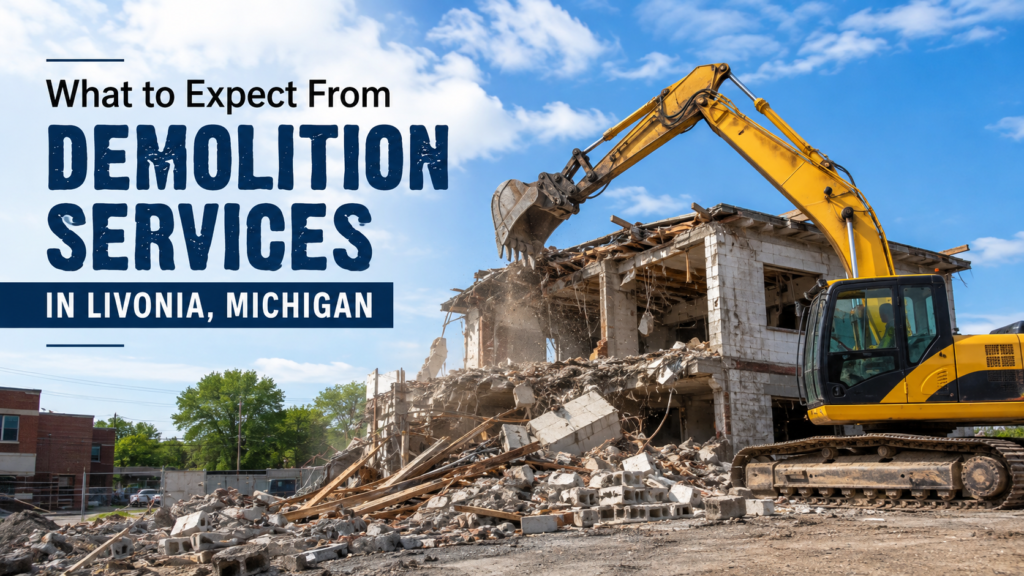
For most residential and smaller commercial projects, mechanical demolition using excavators and similar heavy equipment is the standard approach. Larger industrial buildings may require a phased demolition plan, where interior systems and equipment are removed first, followed by the building shell. Interior demolition alone, without touching the exterior structure, is also common in Livonia’s commercial spaces as they are prepared for new tenants.
For a mid-sized commercial building along one of Livonia’s retail corridors, a hybrid approach is sometimes used, combining selective interior removal with mechanical demolition of the exterior shell once interior systems have been cleared.
Debris Recycling and Disposal
Demolition debris is typically sorted on-site to separate recyclable materials such as concrete, metal, and wood from general waste. This is especially significant for industrial demolition projects, which often generate large volumes of structural steel and concrete that can be recycled rather than landfilled, reducing both environmental impact and disposal costs.
Some industrial sites also include specialized equipment or fixtures that have value beyond basic scrap recycling, such as machinery, tanks, or piping systems. Identifying which of these items can be resold or repurposed, versus what needs to be processed as standard scrap, is often part of the early planning discussion for a larger industrial demolition project.
Safety Planning in Mixed-Use Areas
Because Livonia includes residential neighborhoods situated near commercial and industrial zones, safety planning often needs to account for nearby traffic, adjacent businesses, and residential proximity. This can include coordinated scheduling to limit disruption, clear site fencing, and dust and noise control measures appropriate to the scale of the project.
Signs a Structure May Need Demolition Rather Than Repair
Whether the property in question is a post-war ranch home or an aging industrial building, a few structural indicators tend to point toward demolition rather than continued repair. These include significant foundation movement, widespread water intrusion affecting framing or structural steel, and, for industrial buildings specifically, outdated infrastructure that would be more costly to modernize than the value of the existing structure. A structural assessment early in the process helps property owners understand whether renovation remains a realistic option.
Mechanical Demolition vs. Selective Deconstruction
The demolition method chosen for a Livonia project depends on the structure and the goals involved. Mechanical demolition using excavators is the standard approach for full residential teardowns and most straightforward commercial buildings, offering an efficient way to bring down a structure. Selective deconstruction, a more hands-on approach, is used when specific materials, equipment, or building components need to be carefully removed, which is common in industrial settings where machinery or fixtures may have value or require special handling before the building shell comes down.
How Seasonal Weather Affects Project Scheduling
As with much of Southeast Michigan, seasonal weather influences when larger demolition projects are scheduled in Livonia. Frozen or saturated ground can complicate excavation and grading work during the winter and early spring, leading many property owners and businesses to plan larger projects for the late spring through fall months. Interior demolition, which does not involve exterior excavation, is generally less affected by seasonal conditions and can often proceed throughout the year.
Planning Around Livonia’s Road Network
Livonia’s layout includes several major thoroughfares, including Plymouth Road, Schoolcraft Road, and Middlebelt Road, all of which see significant daily traffic. For larger demolition projects, particularly commercial or industrial jobs, contractors often need to coordinate equipment delivery, debris hauling, and truck routes around peak traffic periods to minimize disruption to both the project schedule and the surrounding community.
Environmental Review for Former Industrial Sites
Some of Livonia’s older industrial properties may have a history of manufacturing processes that leave behind soil or groundwater considerations beyond the building itself. In these cases, an environmental review is sometimes conducted alongside the standard hazardous materials survey to determine whether any additional remediation steps are needed as part of the overall demolition and site preparation plan.
What Happens on Demolition Day
For a residential project, demolition day typically begins with a final confirmation that utilities are disconnected and the site is secured, followed by a structural teardown that is often completed within a single day for a typical single-family home. Commercial and industrial projects generally follow a more phased schedule, with interior systems, equipment, or fixtures removed before the building shell itself is addressed, which can extend the active demolition period over several days or weeks depending on the building’s size and complexity.
After the Structure Comes Down
Once the visible structure has been removed, remaining steps include foundation removal, backfilling the excavated area, and confirming that all utility lines have been properly capped below grade. Final site grading ensures the lot drains correctly, which is particularly important for larger commercial and industrial sites where improper drainage can affect not just the property itself but surrounding parcels as well.
Frequently Asked Questions
Do I need a permit to demolish a garage in Livonia? Yes, demolition permits typically apply to accessory structures as well as full homes or commercial buildings.
How is industrial demolition different from residential demolition? Industrial projects generally involve more complex structural review, larger utility disconnections, and sometimes the removal of manufacturing equipment before the building itself is torn down.
What materials are commonly recycled during demolition? Concrete, structural steel, and other metals are frequently recycled, particularly on larger commercial and industrial projects.
How long does a commercial demolition take in Livonia? Timelines vary widely based on building size and complexity, with larger industrial projects often taking several weeks from permitting through final cleanup.
Are older Livonia homes likely to contain asbestos? Homes built before the 1980s have a higher likelihood of containing asbestos in certain materials, which is why a hazardous materials survey is a standard precaution.
Does an industrial building’s prior use affect the demolition plan? Yes, buildings previously used for manufacturing or chemical processing may require additional environmental review before demolition can proceed, depending on what materials were historically stored or used on-site.
Can a portion of a commercial building remain occupied during demolition of another section? In some cases, yes, particularly for interior demolition projects, though this requires careful planning to maintain safe separation between the active work zone and any occupied spaces.
Residents and business owners researching a demolition contractor in Livonia will find that the city’s mix of post-war residential neighborhoods and active industrial corridors each come with their own set of demolition considerations.